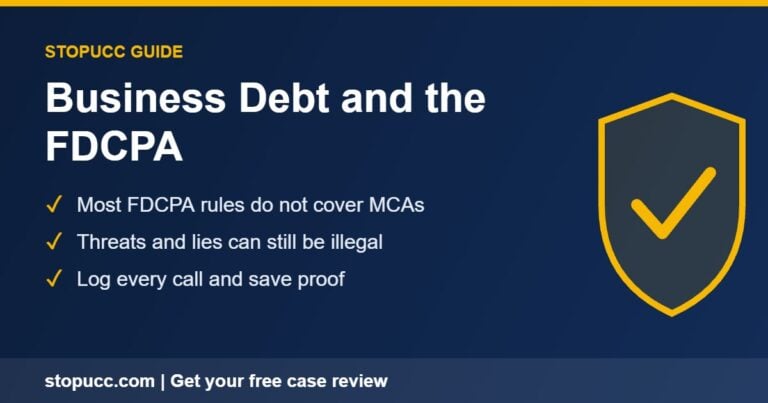

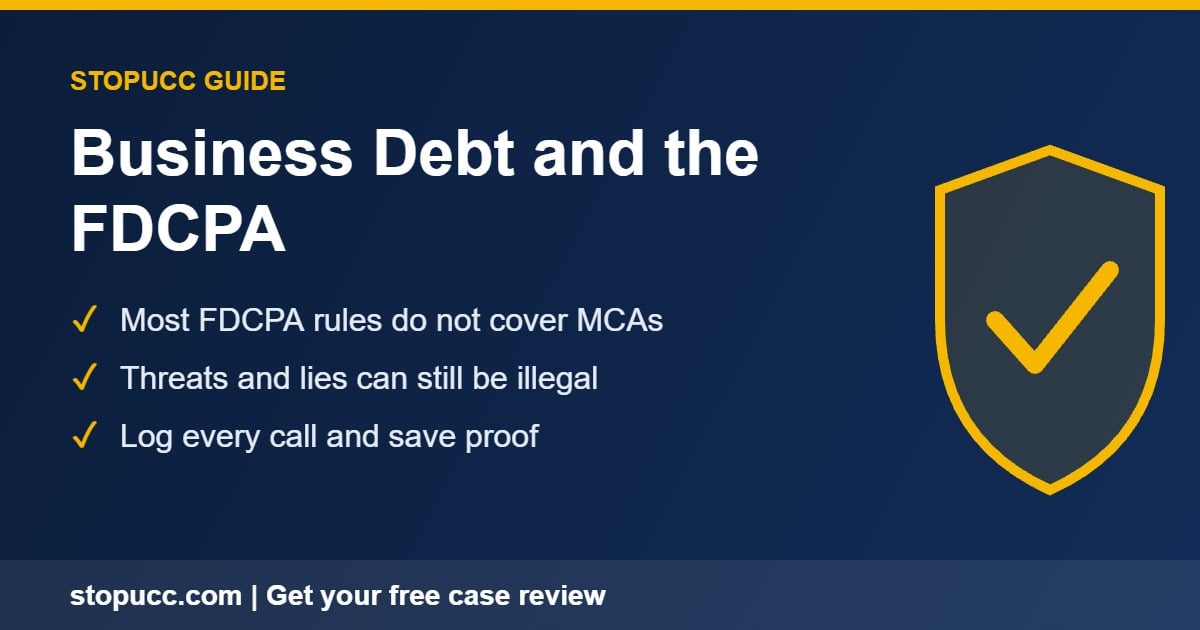
Quick answer: Does the FDCPA apply to business debt? In most cases, no. The federal Fair Debt Collection Practices Act (FDCPA) only covers debts for personal, family, or household use. A merchant cash advance (MCA) is a business debt, so most FDCPA rules do not apply. But MCA collectors still cannot threaten you, lie to you, or break other laws.
Many owners get a shock when an MCA payment goes unpaid. They expect the same rules that protect people with credit card debt. Then the calls start, and the rules seem to vanish.
Here is the truth. Business debt has fewer federal guardrails. That does not mean collectors can do anything they want. Other laws still apply, and courts and regulators have punished MCA firms for crossing the line.
An MCA is money a funder gives your business now. In return, you sell a share of your future sales. The funder usually pulls payments from your bank account each day or week by ACH. ACH means an automatic electronic transfer.
This guide explains what MCA collectors can and cannot do. It also shows you how to protect your company when they come calling.
Does the FDCPA Apply to Business Debt?
The FDCPA is a federal law. Congress passed it in 1977. It limits how debt collectors treat people who owe money.
The law defines “debt” in a narrow way. It must come from a deal made mainly for personal, family, or household purposes. You can find that definition at 15 U.S.C. 1692a(5).
An MCA is made for a business. So the FDCPA usually does not cover it. That means a few key consumer rules may not help you:
- The rule against calls before 8 a.m. or after 9 p.m.
- The right to send a letter telling a collector to stop contacting you.
- The rule requiring a written notice that explains the debt.
What About My Personal Guarantee?
Most MCA contracts include a personal guarantee. That is your promise to pay if the business does not. It can put your own savings and property at risk.
Many owners think the guarantee makes it a personal debt. In most courts, it does not. Judges look at why the money was taken in the first place. If it was for the business, the debt usually stays a business debt. That is true even when the funder chases you as the guarantor.
What MCA Collectors Can and Cannot Do
No FDCPA does not mean no rules. Here is what still limits MCA collectors.
1. The FTC Act still applies. Section 5 of the FTC Act bans unfair or deceptive acts. The Federal Trade Commission (FTC) has used it against MCA firms. In 2023, a federal judge in New York found that threats used to collect MCA payments were unfair. That ruling came in the FTC’s case against RCG Advances. The court later barred one defendant from the MCA and debt collection industries.
2. State attorneys general can act. In January 2025, New York’s Attorney General announced a $1.065 billion judgment against Yellowstone Capital and related companies. The state said many of the deals were really loans dressed up as MCAs. About $534 million in merchant balances were canceled. The firm and its officers were banned from the MCA business.
3. Threats and lies are still off limits. Threats of violence can be crimes. Lies can lead to fraud claims. Reaching out to your customers with false claims can lead to a claim called tortious interference.
4. Contract terms still matter. A collector can only use the tools your contract and the law allow. Read your MCA agreement closely. Look at what it says about reconciliation, default, and collections.
5. Confessions of judgment have limits. A confession of judgment is a paper you sign in advance. It lets a funder get a court judgment fast, often without a hearing. Since August 30, 2019, New York courts no longer accept these from out of state borrowers.
What MCA Collectors Often Do When You Fall Behind
Since 2014, we have seen the same pattern in this industry. Collectors know most owners think consumer rules protect them. They use that confusion to create fear and fast payments.
Common moves include:
- Many calls a day to you, your partners, and your staff.
- Emails that say a lawsuit is “already filed” when it may not be.
- Contact with your customers about the money they owe you.
- A fast lawsuit or a confession of judgment.
- A bank account freeze after a judgment.
Some of these steps are legal. Some are not. The details depend on your contract, your state, and the facts.
How to Protect Your Business From MCA Collection Harassment
You cannot control what a collector does. You can control how ready you are.
- Write everything down. Log each call with the date, time, name, and what was said.
- Save every message. Keep emails, texts, and voicemails. Do not delete anything.
- Talk in writing when you can. Ask the collector to send all requests by email.
- Do not make promises on the phone. Fear makes owners agree to terms they cannot keep.
- Check your numbers. Add up all your daily MCA payments. If they take more than 25% of your daily sales, you are in the danger zone.
- Ask for a reconciliation. Many MCA contracts let you ask to lower payments if sales drop.
- Get help early. A qualified professional can review your contract before things get worse.
Never hide or move assets to dodge a creditor. That can be illegal and can make your case much worse.
Quick Checklist
- I know my MCA is likely business debt, not consumer debt.
- I have read my contract’s default and reconciliation terms.
- I keep a log of every collection call.
- I have saved all emails, texts, and voicemails.
- I know my total daily MCA payments as a share of sales.
- I have a professional ready to review my case.
Common Questions
Can an MCA company call me every day? Usually, yes. The FDCPA call limits do not cover business debt. But threats, lies, and abusive conduct can still break other laws.
Can an MCA collector call my customers? They may contact customers in some cases. False or harmful claims to your customers can lead to legal claims against the funder.
Who do I report MCA collection harassment to? You can file a complaint with your state attorney general or the FTC. Keep copies of your proof.
Related StopUCC Guides
- Can they really freeze your business bank account?
- How to stop MCA auto withdrawals legally
- When MCA funders contact your customers
- Legal defenses when MCA companies cross the line
You Are Not Alone
Many owners face MCA collectors. You do not have to do it alone. For news and support, visit MCA Wars. If you are weighing other business funding, LendDEFY works with businesses looking for commercial capital.
This article is for education only. It is not legal, financial, or tax advice. Laws are different in each state. Talk to a qualified professional before you make decisions about your business debt.
Created, Customized and Powered by Velocity Business LLC
About The Author