
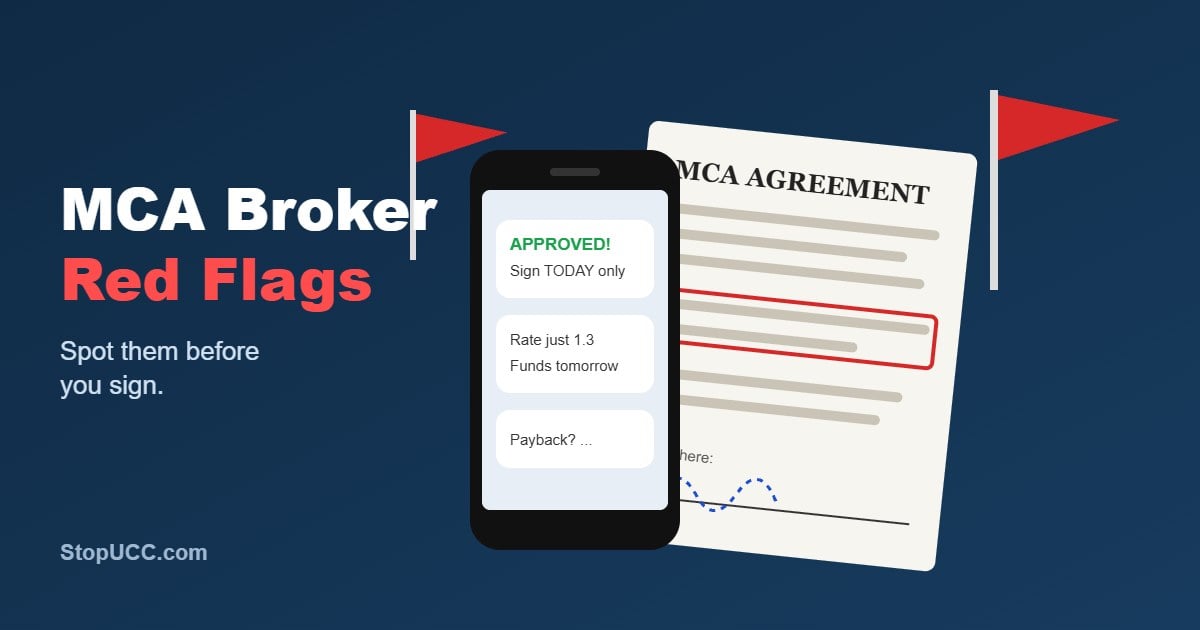
Quick answer: A bad MCA broker pushes you to sign fast. They hide the real cost. They talk about “approval” but not payback. They tell you to take a second advance before the first is paid. If you hear these things, stop. Get the full cost in writing before you sign anything.
Your phone rings. A friendly voice says you are approved. The money can be in your bank account tomorrow.
That feels like a lifeline. Maybe payroll is due. Maybe a big bill just landed.
But the call is a sales pitch. The person on the phone is often a broker. A broker is a middleman. They connect you with a funder and get paid when you sign.
Many brokers are honest. Some are not. We have worked in commercial lending and MCAs since 2014. We have seen the same warning signs again and again. Here is how to spot them.
First, a Few Plain Words
An MCA is a merchant cash advance. A funder gives you cash now. In return, you sell them a part of your future sales.
A factor rate sets how much you pay back. Say the rate is 1.45. You pay back $1.45 for every $1 you get.
ACH means an automatic bank pull. Most MCAs take money from your account every business day this way.
A UCC lien is a public notice. It says the funder has a claim on your business assets. You can learn more in our guide on the UCC-1 blanket lien.
7 Red Flags in an MCA Broker’s Pitch
1. “You have to sign today.”
Pressure is the biggest red flag. A fair deal will still be there tomorrow. Rush tactics stop you from reading. They stop you from asking an expert.
2. They talk about the rate, not the payback.
A broker may say “only 1.3.” That sounds small. It is not an interest rate. Ask for the total dollars you will pay back. Ask for the daily or weekly payment too.
3. They will not send the contract early.
You should see the full contract before signing day. If they only send a quick e-sign link, slow down. Read every page. Look for a personal guarantee. Look for a confession of judgment.
A personal guarantee means you promise to pay with your own money if the business cannot. Read our post on the personal guarantee trap.
A confession of judgment is a paper where you agree ahead of time that the funder wins in court. You give up your chance to fight back first.
4. They want you to take a second advance.
This is called stacking. A broker may say a new advance will “help you catch up.” But now you have two daily pulls. Each one takes from the same sales. See why in our post on MCA stacking.
5. They promise it is “not a loan, so no rules apply.”
An MCA is not set up like a regular loan. That is true. But it does not mean anything goes. Some states now make funders show the cost in writing. California’s rules took effect on December 9, 2022. New York’s rules took effect on August 1, 2023. Other states have passed similar laws.
6. They will not say who the funder is.
You have a right to know who is giving you money. You also need to know who will pull from your bank. If the broker dodges this, walk away.
7. They push you to hide your other debts.
Some brokers tell owners to leave out other advances. That can break the contract you sign. It can also hurt you later in a dispute. Tell the truth on every form.
Run the Numbers Before You Sign
Here is an example. These numbers are made up to show the math.
- You get $50,000.
- The factor rate is 1.45.
- You pay back $72,500.
- The term is 120 business days.
- Your daily payment is about $604.17.
Now say your sales are $2,000 a day. That payment is about 30.2% of your daily sales.
At StopUCC, we use a simple rule. Add up all your daily MCA payments. If they are more than 25% of your daily sales, you are in the danger zone. In this example, 25% would be $500 a day. The payment is more than that.
Do this math for every offer. Do it again with the payments you already have.
Better Questions to Ask Any Broker
- What is the total payback in dollars?
- What is the daily or weekly payment?
- Who is the funder?
- Is there a personal guarantee?
- Is there a confession of judgment?
- Will the funder file a UCC lien?
- Can I pay early and save money?
- How are you paid for this deal?
A good broker will answer every one. A bad one will change the subject.
You may also want to compare other kinds of business funding first. LendDEFY works with businesses looking for commercial capital. Comparing options gives you a fair view before you sign.
If you are new to how MCAs work, start with our guide on what a merchant cash advance is.
Quick Checklist Before You Sign
- I have the full contract in hand.
- I know the total payback in dollars.
- I know the daily or weekly payment.
- My total daily payments stay under 25% of daily sales.
- I know the name of the funder.
- I checked for a personal guarantee.
- I checked for a confession of judgment.
- I am not taking this to pay off another advance.
- I took at least one night to think.
Common Questions
Is every MCA broker a scammer? No. Many brokers do fair work. The red flags above help you tell the difference.
Can I back out after I sign? It depends on the contract and your state. Read it closely. Talk to a professional fast if you have doubts.
What if I already signed a bad deal? You still have options. Keep every paper and bank statement. Do not take a new advance to fix the old one. Get help early.
You Are Not Alone
Many owners have been where you are. For news and support, visit MCA Wars.
If an MCA is already squeezing your business, talk to us. Get Your Free Case Review
This article is for education only. It is not legal, financial, or tax advice. Laws are different in each state. Talk to a qualified professional before you make decisions about your business debt.
Created, Customized and Powered by Velocity Business LLC
About The Author