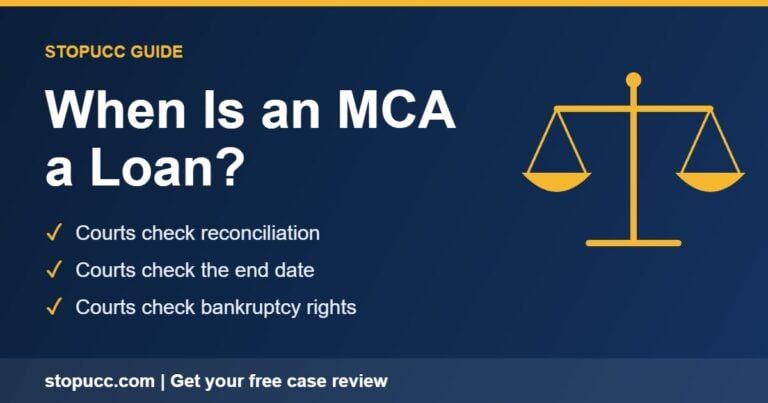

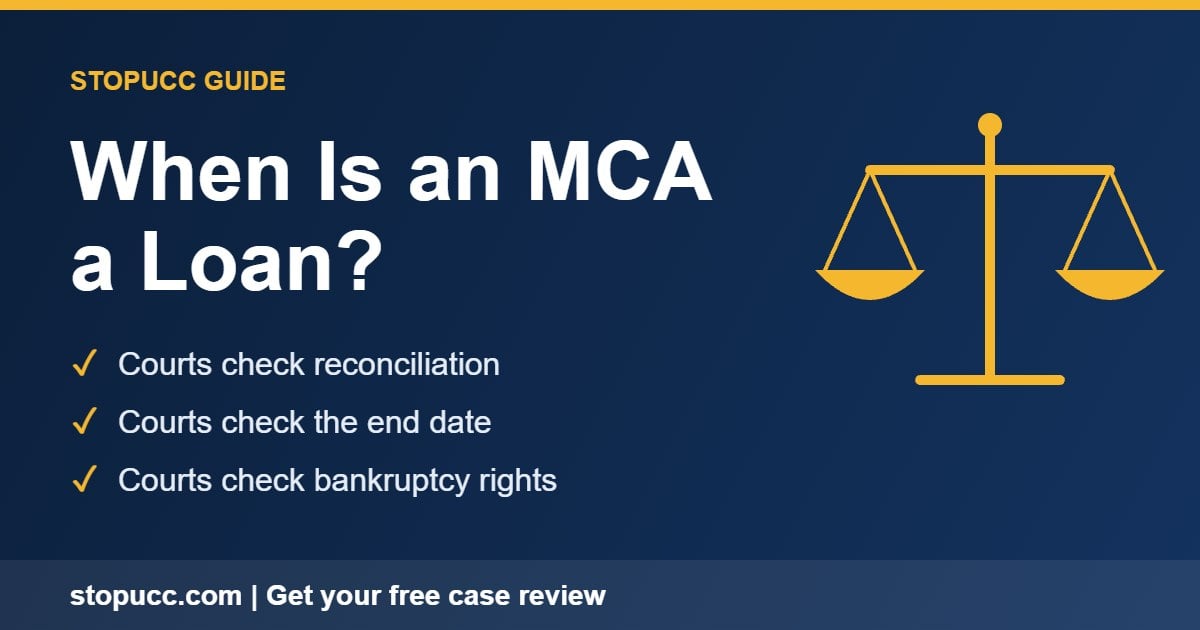
Quick answer: When is an MCA a loan? A court may call it a loan if you must repay no matter what your sales do. New York courts check three things. Is there a real reconciliation clause? Is there a set end date? What happens if you file bankruptcy? If the deal fails that test, usury laws may apply, and that can change your case.
A merchant cash advance (MCA) is money a funder gives your business now. In return, the funder buys a share of your future sales. Funders call it a “purchase,” not a loan.
That word matters a lot. Loans must follow interest rate limits. A true sale of future sales does not.
So when a funder sues you, one big question often comes up. Is this deal really a sale? Or is it a loan in disguise? This guide shows how courts decide, in plain words.
We are StopUCC. We help business owners who face MCA default, UCC liens, and hard collection. Here is what you should know.
Why does it matter if an MCA is a loan?
Most states have usury laws. Usury means charging more interest than the law allows.
In New York, the civil usury cap is 16% a year. The criminal usury cap is 25% a year. Most companies cannot use the civil cap as a defense. But New York lets companies raise criminal usury as a defense in many cases.
In 2021, New York’s highest court ruled in Adar Bays, LLC v. GeneSYS ID, Inc. It said a loan that breaks the criminal usury law is void when a company raises that defense. Void means the lender cannot collect the principal or the interest.
MCA costs can be very high. So if a court calls your MCA a loan, the funder’s whole case can change.
When is an MCA a loan in the eyes of a court?
The key question is simple. Is your payback “absolute” or “contingent”? Absolute means you owe it no matter what. Contingent means you owe it only if your sales come in.
In March 2020, a New York appeals court (Appellate Division, Second Department) decided LG Funding, LLC v. United Senior Properties of Olathe, LLC. It named three factors courts usually weigh:
- Is there a reconciliation clause? Reconciliation means the funder must lower your payment if your sales drop. The clause must be real, not just up to the funder.
- Does the deal have a set end date? A true purchase of future sales has no fixed term. If you must pay in full by a date, it looks like a loan.
- What happens if you file bankruptcy? Can the funder still collect from you after a bankruptcy? Then it looks like a loan.
No single factor decides the case. Courts look at the whole contract and how it worked in real life.
A real example: Fleetwood Services
In June 2022, a federal court in New York ruled for a business called Fleetwood Services. It found the business’s MCA was really a usurious loan.
In June 2023, the federal appeals court for the Second Circuit agreed. The contract failed two factors. Payment changes were up to the funder’s “sole discretion.” And the funder could still go after the personal guarantors if the business filed bankruptcy.
This does not mean every MCA is a loan. Many courts have found MCAs to be real sales. Every contract is different. The wording counts.
Example: what “absolute” payback looks like
Here is an example with made up numbers.
- You get $50,000 with a 1.4 factor rate. A factor rate is the number the funder multiplies your advance by to set your payback.
- So you owe $70,000. That is $20,000 more than you got.
- The funder takes $583.33 each business day by ACH. ACH is an automatic bank withdrawal.
- That pays the full $70,000 in 120 business days.
Now say your daily sales drop to $2,000. That payment is about 29% of your daily sales. At StopUCC, our rule of thumb is simple. If all your daily MCA payments add up to more than 25% of daily sales, you are in the danger zone.
If the funder will not lower the payment when sales fall, ask why. When is an MCA a loan? Often, when the payment never bends. A deal that takes the same amount no matter what can start to look like a loan.
Signs your MCA may look like a loan
Read your contract with these red flags in mind:
- The payment never changes, even when sales fall.
- The reconciliation clause says changes are at the funder’s “sole discretion.”
- There is a set number of days or a due date.
- Your personal guarantee covers the debt if the business closes or files bankruptcy.
- The contract has a confession of judgment. That is a paper you sign ahead of time. It lets the funder get a court judgment fast, without a full trial.
From years in the MCA industry, here is one thing we know. Many contracts have a reconciliation clause on paper. Far fewer owners ever ask to use it. Asking in writing creates a record. You can learn more in our guide on records to keep with an MCA.
What should you do if you think your MCA is a loan?
- Get your full contract. Get every page, plus any add ons.
- Pull your bank records. Mark every MCA withdrawal and the date.
- Ask for reconciliation in writing. Send your real sales numbers. Keep a copy.
- Do the math. Add up what you got and what you paid back.
- Do not ignore a lawsuit. Deadlines are short. Read your legal rights when an MCA company sues.
- Talk to a lawyer who knows MCA cases. Usury defenses depend on your state and your contract.
Want the basics first? See our guide on what a merchant cash advance is and how it differs from a loan. If you signed a confession of judgment, read the confession of judgment loophole.
Quick checklist
- I have my full MCA contract.
- I found the reconciliation clause and read it.
- I checked for a set end date or due date.
- I checked what happens if I file bankruptcy.
- I know if I signed a personal guarantee.
- I added up my daily payments against my daily sales.
- I asked for reconciliation in writing and kept a copy.
Common Questions
Is a merchant cash advance a loan or not? It depends on the contract. Courts look at reconciliation, the end date, and bankruptcy rights. Some MCAs are found to be loans. Many are not.
Can I use usury as a defense in an MCA lawsuit? Maybe. It depends on your state and your deal. In New York, companies can raise criminal usury in many cases. A lawyer can tell you if it fits.
What if my MCA funder will not reconcile my payments? Ask in writing and send proof of your sales. Keep copies. A funder that refuses may weaken its claim that the deal is a true sale.
You Are Not Alone
Many owners face this fight. For news and support, visit MCA Wars. If you are weighing other kinds of business funding, LendDEFY works with businesses looking for commercial capital.
This article is for education only. It is not legal, financial, or tax advice. Laws are different in each state. Talk to a qualified professional before you make decisions about your business debt.
Created, Customized and Powered by Velocity Business LLC
About The Author