
Quick answer: Here is how to look up UCC filings on your business. Go to the Secretary of State website in the state where your company was formed. Find the UCC search page. Type your business name exactly as it shows on your formation papers. Read every UCC-1 that comes up, and save a copy of each one.
Do you know who has a claim on your business right now? Many owners do not. They find out when a bank says no to a new loan. Or they find out when a funder starts to collect.
A UCC lien is a public notice. It says a lender or funder has a claim on some of your business property. It is filed on a form called a UCC-1. UCC stands for Uniform Commercial Code. That is a set of business rules nearly every state uses.
An MCA is a merchant cash advance. A funder gives you cash now. In return, it takes a cut of your future sales. Most MCA funders file a UCC-1 on the day you get funded. Some file more than one.
These filings are public. You can look them up yourself, often for free. This guide shows you how.
Why should you do a UCC lien search on your own business?
A UCC lien search shows you what the world sees. Lenders check it before they say yes. So do some landlords and big customers.
Here is what a search can tell you:
- Which funders and lenders have filed on you
- What property each filing covers
- When each filing was made
- Whether an old filing is still sitting there after you paid
Some filings cover just one item, like a truck. Others claim almost everything you own. That kind is called a blanket lien. You can learn more in our guide to the UCC-1 blanket lien.
In my years in commercial lending and MCA since 2014, I have seen this many times. Owners often have more UCC filings than they think. A broker may have shopped their file to several funders. Each one that funded filed its own UCC-1.
How to look up UCC filings, step by step
Follow these steps. They work in most states.
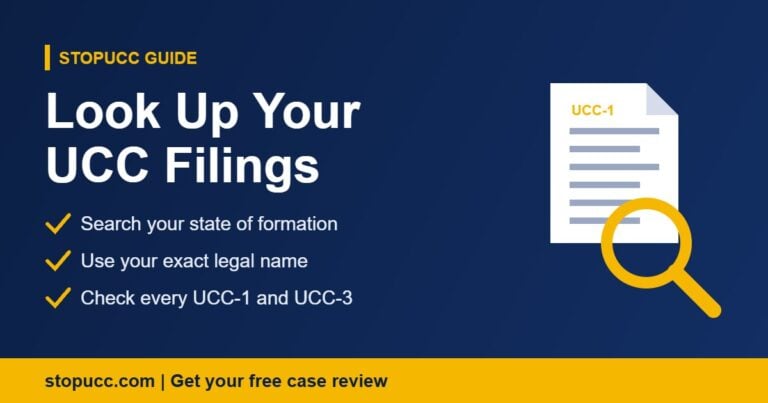
- Pick the right state. For an LLC or corporation, search the state where it was formed. That is the state where you filed your setup papers. It may not be where you work. A Delaware LLC is searched in Delaware.
- Go to the Secretary of State website. In most states, the Secretary of State keeps UCC records. A few states use a different office. Search the web for your state name plus “UCC search.”
- Search by your exact legal name. Use the name on your formation papers. Leave out nothing. Small changes in a name can change the results.
- Try a few other names, too. Search old names and trade names. Search common typos. A funder may have filed with a small mistake.
- Open every result. Read who filed it. That is the “secured party.” Read what it covers. That is the “collateral.”
- Look for later changes. A UCC-3 is a change form. It can add, change, or end a filing. Check if any UCC-3 is tied to each UCC-1.
- Save copies. Download or print each filing. Write down the file number and date.
If your state’s site is hard to use, you can ask for an official search. Many states call this a UCC-11 request. There is often a small fee.
What do you look for on each UCC-1?
Each UCC-1 has a few key parts. Check them all.
- Debtor name. That is your business. Make sure it is right.
- Secured party. That is the funder or lender. Do you know them?
- Collateral. This says what they claim. “All assets” means a blanket lien.
- File date. Note this. It tells you when the filing ends.
Be careful with names you do not know. Some funders use a different company name to file. Some sell your contract to another company. The name on the filing may not match the name you dealt with. Compare it to your contract.
How long does a UCC filing last?
Under UCC Section 9-515, a UCC-1 lasts five years. Then it ends on its own. This is called a lapse.
A funder can keep it alive. It files a continuation within six months before the five years end. That adds another five years.
So an old filing can stay a long time.
What if a UCC filing should not be there?
Sometimes a filing stays after you paid in full. That can block new funding.
Under UCC Section 9-513, you can send the funder a written demand. If you owe nothing more, the funder must act. It has 20 days to file a termination or send you one. A termination is a UCC-3 that ends the filing.
You may also find a filing you think is wrong. Many states let you file a note in the record that says so. This does not erase the filing. But it puts your side on file.
Our guide UCC liens explained, and how to remove them goes deeper on this.
Keep good proof of every payment. Our post on what records to keep with an MCA shows you what to save.
How a UCC lien search helps you plan
Your search is a map. It shows who can make a claim first. It also shows who you may need to talk to.
Use it to plan your next move:
- Count how many funders have filed on you
- Add up what you pay them each day
- Compare that to your daily sales
Here is a StopUCC rule of thumb. Add up all your daily MCA payments. Is it more than 25% of daily sales? Then you are in the danger zone.
Example only: say your sales are $4,000 a day. Your MCA payments add up to $1,100 a day. That is 27.5% of sales. That is over the line.
If you are shopping for better business funding, compare options with care. LendDEFY works with businesses looking for commercial capital.
Your UCC search checklist
- Found the state where your business was formed
- Searched your exact legal name
- Searched old names, trade names, and typos
- Saved a copy of every UCC-1 and UCC-3
- Wrote down each secured party and file date
- Matched each filing to a contract you signed
- Flagged any filing for a debt you already paid
Common Questions
Can I look up UCC filings on my business for free? In many states, yes. The Secretary of State website often has a free search. An official certified search may cost a fee.
How do I find out who has a lien on my business? Do a UCC search by business name in the state where you formed your company. Each result names the secured party. That is who filed the claim.
Does a UCC lien hurt my business credit? It can make lenders careful. Many lenders check UCC filings before they fund. Too many filings can lead to a no.
You Are Not Alone
You do not have to sort this out alone. For news and support from other owners, visit MCA Wars. To learn the basics first, read what a UCC lien is.
This article is for education only. It is not legal, financial, or tax advice. Laws are different in each state. Talk to a qualified professional before you make decisions about your business debt.
Created, Customized and Powered by Velocity Business LLC
About The Author